In recent years, several high-profile footbridges such as the London Millennium Bridge have suffered from unexpected excessive pedestrian-induced lateral vibrations. There is a commonly accepted view that the synchronisation of pedestrian walking to the lateral movement of a structure is necessary for the onset of a form of instability which may lead to large lateral responses. Several recently published load models are based on this assumption. Yet, few experimental studies exist to support this hypothesis.
Background and Motivation
On June 10th 2000, one of the world´s most innovative pedestrian bridges was opened to the public for crossing. The Millennium Bridge over the Thames River in London was, as its name suggests, a British Millennium Project. Ninety thousand people gathered to cross the bridge on the first day, with up to 2000 people on the bridge at any one time. From the very first moments of its opening it became apparent that the bridge was moving laterally. Few days later, the bridge was closed for public while a retrofit solution was designed and implemented. Since then, various researchers have produced load models to predict the vibration of the bridge. Nevertheless, to date, none of the existing pedestrian load models can produce responses that fully match the behaviour of the bridge, as found from full-scale measurements conducted during the 18 month closure.

London Millennium Footbridge, UK
The innovative design and particular geometry of the London Millennium Bridge was not the cause of excessive lateral vibrations. Several other bridges of different length and type have also been found prone to similar excessive lateral vibrations when exposed to large pedestrian crowds. Their only common characteristics are low natural frequency of lateral modes and a large number of pedestrians. So as bridges and other line-like structures become longer and lighter, their susceptibility to pedestrian-induced loading generally increases. However, existing national and international bridge codes (and design guidelines) do not provide bridge designers with sufficient information on how to calculate the effect of pedestrian induced vibrations.
Human-structure synchronization
The lateral footbridge vibrations have often been attributed to a synchronisation between the pedestrian and the bridge, commonly denoted “lock-in” or “Synchronous Lateral Excitation” (SLE). This refers to the observation that pedestrians seem to modify their gait to match the frequency and phase to that of the bridge. This has lead to the development of several sophisticated pedestrian load models, which rely on this assumption. Nevertheless, there is a general dispute regarding the fundamental nature of human-structure interaction and the importance of synchronisation.
An important finding from the pedestrian tests carried out on the London Millennium Bridge, is that the pedestrian force was strongly related to the velocity of the structure, suggesting that pedestrians act as “negative dampers” on the structure. This supports the idea that excessive lateral vibrations occur when a critical number of pedestrians produce sufficient negative damping to cancel the inherent structural damping. An equally important observation is that the vertical response of the structure at twice the modal frequency did not show any disproportionate increase, as an expected consequence of synchronised walking frequencies. Similar observations on the lack of synchronised vertical loads during excessive lateral vibrations, have been reported on other occasions, but largely ignored in the load models that rely on synchronised stepping.
The contradictory conclusions about the origin of the human-structure interaction raise two obvious questions:
1. What is the load induced by pedestrians walking on a laterally oscillating surface as function of vibration frequency and amplitude?
2. 2. Is synchronisation a necessary trigger for the development of diverging lateral vibrations?
As a first step towards answering these questions, a preliminary experimental investigation utilising a 17m long laboratory platform was carried out. By measuring the lateral acceleration response of the platform and monitoring the movement of the pedestrians, the effect of single pedestrians and crowds were studies. With its low natural frequencies (0.63 and 0.93 Hz) and relatively large modal mass (20 t and 6.5 t), the platform provides a realistic comparison with an actual footbridge. The results from the platform investigations were used as a basis for the development of a larger experimental campaign.

Pedestrian crow tests at DTU Civil Engineering.
Experimental campaign
An extensive experimental campaign has been carried out to determine the lateral forces generated by pedestrians during walking on a laterally moving treadmill. The work is a result of an ongoing collaboration between CESDYN (DTU), University of Reggio Calabria and CRIACIV at the University of Florence and was carried out in the period from 1st of May – to 1st of August 2009.
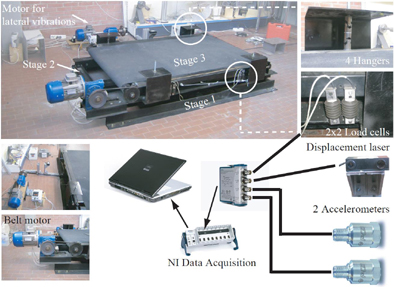
Instrumented Treadmill Ergometer Device located at CRIACIV in Prato, Italy.
Two different conditions were investigated; initially the treadmill was fixed and then it was laterally driven in a sinusoidal motion at varying combinations of frequencies (0.33 - 1.07 Hz) and amplitude (4.5 – 48 mm). The experimental campaign involved 71 test subjects and covered approximately 55 km of walking distributed on almost 5000 individual tests.
An in-depth analysis of the movement of the pedestrians that participated in the experimental campaign reveal that synchronisation is not a pre-condition for the development of large amplitude lateral vibrations on footbridges, as walking frequencies remain largely unaffected by the lateral motion.
Instead, large amplitude vibrations are the result of correlated pedestrian forces in the form of negative damping that can be generated irrespective of the relationship between the walking frequency and the frequency of the lateral movement. These forces are self-excited in the sense that they are generated by the movement of the body's centre of mass, which in turn is caused by the lateral acceleration of the underlying pavement.
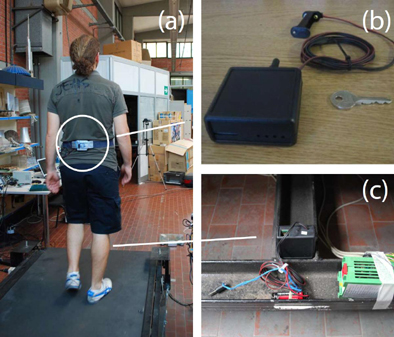
During some of the pedestrian tests, the subjects were equipped with body accelerometers (a). The accelerometers are wireless and time synchronized (b) allowing for a simultaneous measurement of the human body and the treadmill (c).
Pedestrian loading model
Based on the results from the experimental campaign, it was concluded that models of pedestrian loading that rely solely on human-structure phase-synchronisation are insufficient, particularly for structural frequency away from the average walking frequency of a crowd.
From a frequency-domain representation of the measured pedestrian-induced lateral load, two different mechanisms were identified; one centred on the walking frequency (half the pacing rate), and its integer harmonics and one which occurs at the frequency of the lateral motion, denoted the “self-excited force”. Depending on the phase between the self-excited force and the treadmill displacement, the effect of this force on a structure will be to add to or decrease the overall modal mass and/or damping.
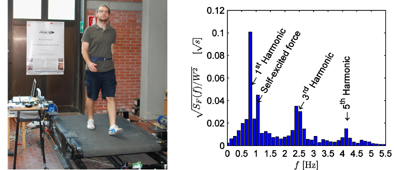
Left: A pedestrian test subject walking on the instrumented and laterally driven treadmill situated at the
CRIACIV boundary layer wind tunnel in Prato, Italy.
Right: An example of the square-root power spectral density of the pedestrian-induced lateral force.
A large inter-subject variability was observed in the tests and thus the load induced by a crowd of pedestrians is governed by randomness. Therefore a probabilistic approach to modelling of human-induced vibrations that relies on experimentally obtained forces is necessary for an accurate estimation of the susceptibility of a footbridge to excessive lateral vibrations. As a part of this research, a novel stochastic load model for the frequency and amplitude dependent lateral forces has been proposed. The parameters in the model are based directly on the measured lateral forces from the experimental campaign. Thereby, the model is a robust and a statistically reliable analytical tool for modeling of pedestrian-induced lateral vibrations.
A series of benchmark simulations have been carried out, showing that the load model can efficiently be used to predict for excessive lateral vibrations of footbridges. It is further shown that the modal response of a footbridge subject to a pedestrian crowd is sensitive to the selection of the pacing rate distribution within the group, the magnitude of ambient loads and the total duration of the load event. The selection of these parameters ultimately affects the critical number of pedestrians needed to trigger excessive vibrations in a particular simulation.
Currently, work is being carried out, to utilise the load model, for the development of a frequency-dependent and probability based stability criterion, which allows designers to obtain a quick estimate of the critical number of pedestrians for a given footbridge.
For more information regarding this project, feel free to contact Einar Thór Ingólfsson at eti@byg.dtu.dk.